
Pressure Washing Cost Per Square Foot in Pinellas County
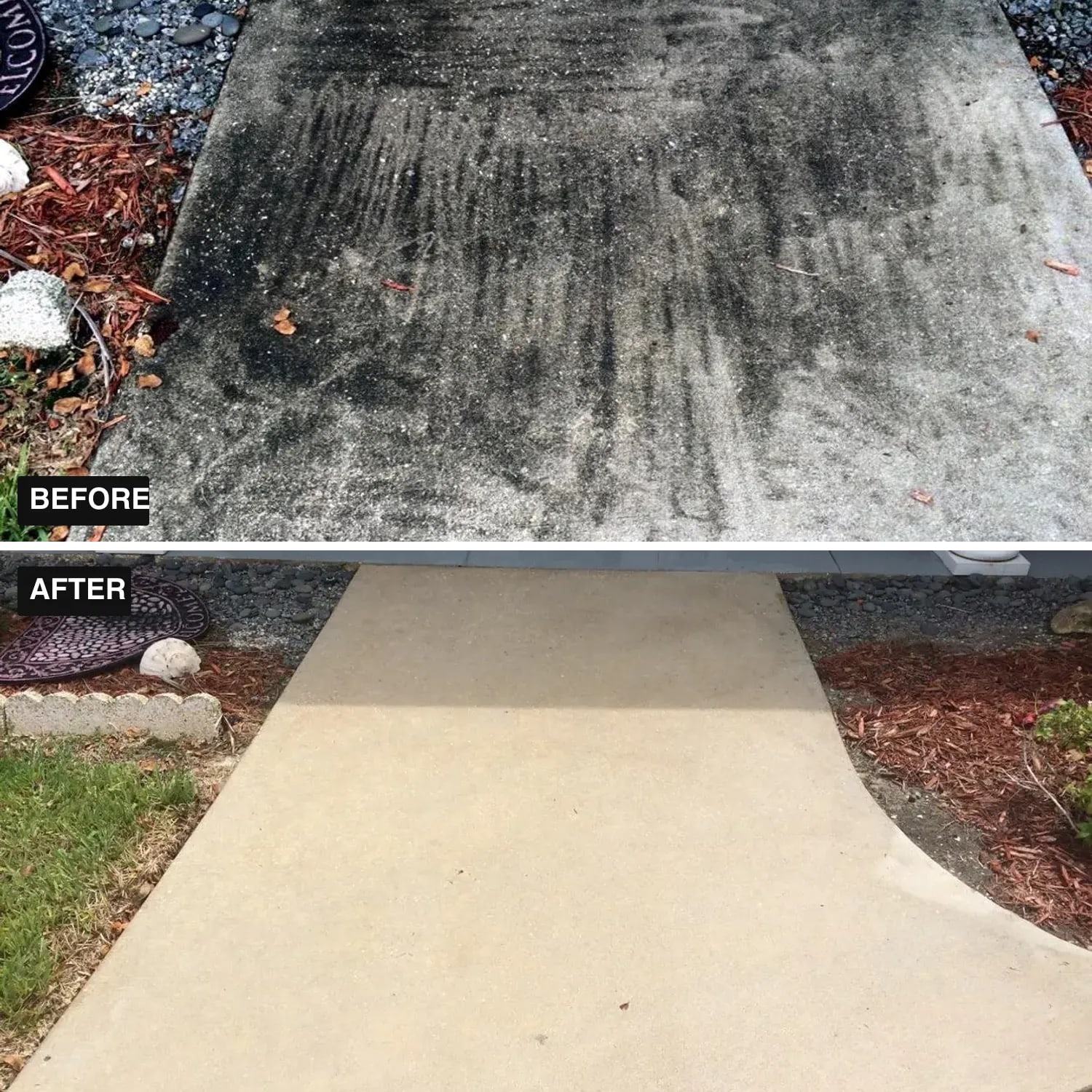
Per-square-foot pricing is a good way to think about flat concrete and a poor way to think about everything else. A driveway is a rectangle you can measure from the street. A roof has pitch, height, material, and an access problem, and a wall has coatings and landscaping in front of it. This page explains where the per-foot number holds up, where it falls apart, and what a real quote prices instead.
Cool Breeze has priced exterior work in Pinellas County since 1999. Here's how the math works, so you can read any company's number and know what it is and isn't telling you.
When does a per-square-foot price work?
A per-square-foot price works on sound, flat concrete, where area is a decent proxy for time. A rotary surface cleaner covers a predictable width per pass, so a slab twice the size takes roughly twice as long. Driveways, sidewalks, and pool decks are the surfaces where a per-foot figure gets you into the right neighborhood.
National directories publish rough Florida ranges for this reason, and Angi's Tampa-area guide is one of the more commonly cited. Treat those as background reading. They aren't a quote for your slab.
When does a per-square-foot price stop working?
A per-square-foot price stops working as soon as access, pitch, or material enters the job, and roofs are the clearest example. Two roofs with the same footprint can be a shallow single-story shingle and a steep two-story barrel tile. The second one has a different access plan, a different walking problem, and a different material risk, and none of that shows up in square footage. The same is true of walls: painted stucco in good condition and chalky oxidized siding aren't the same job at the same area.
Screens are the extreme case. A pool cage is priced by the enclosure, its height, and the condition of the mesh and spline, because those set the limit on what can be done.
What moves the price more than area does?
Five factors move an exterior cleaning price more than area does, and none of them appear in a footprint measurement.
| Factor | What it changes | Why area misses it |
|---|---|---|
| Material and coating | The method used on each surface | Concrete tolerates pressure that painted stucco, screens, and roofing do not |
| Condition | Dwell time, and sometimes a second pass | A surface cleaned within recent memory rinses quickly; years of established growth does not |
| Height and access | The setup, including where a truck can park | Second stories, steep pitches, and tight side yards don't show up in a footprint |
| Protection needs | Pre-wetting, covering, and rinse steps | Dense planting, a koi pond, or an outdoor kitchen adds work the slab size never reveals |
| What is included | The scope itself | Curbing, walkways, side slabs, and downspout flushing count when the quote lists them |
What does Cool Breeze publish?
Our starting estimates begin at $165 for driveway cleaning and $165 for pool-deck cleaning, with some pool-deck estimates extending to $265, and a small lanai cage starting at $185. Those are starting points for simple work, not market averages and not per-foot rates, and the accepted written quote controls the actual price once the property has been reviewed. The pricing page covers how the figures are built.
Roof cleaning and house washing aren't on that list on purpose. Publishing one number for jobs that different would either overcharge simple properties or underquote hard ones, so both are quoted per property. Our house washing cost guide and the county-wide cost factor guide go through the variables.
How do you compare two quotes that use different math?
Compare two quotes on their scope. Look for the same included surfaces, a stated method per material, the precautions for plants and screens, the exclusions in writing, and current insurance documentation on request. Florida's DBPR list of license-requiring services shows which trades need state credentials, which is worth asking about when a scope crosses into repair territory.
A one-line text that names a figure and nothing else isn't a quote. It's a guess, and guesses grow on the day of service.
What is the short version?
Use per-foot thinking for flat concrete and ignore it everywhere else. For roofs, walls, and enclosures, you need a walkthrough and then a document you can hold someone to. Estimates are free, and senior discounts are available when you ask. City details are on the Clearwater and St. Petersburg pages.
Pricing FAQs
Why do companies quote per square foot at all?
Because area is the one input that's easy to measure and easy to compare. It works well enough on flat concrete, where one pass looks like the next.
It works poorly on roofs and walls, where pitch, height, material, and access change the work far more than the footprint does.
Is a per-square-foot quote a red flag?
Not by itself. It's a problem when it's the only thing in the quote. A number with no stated method, no per-surface plan, no precautions, and no exclusions isn't comparable to one that has them.
Ask for the scope behind the figure before comparing two bids.
What makes two same-size houses price differently?
Stories and reach, siding material and its condition, how established the buildup is, how close the landscaping is to the walls, whether a truck can park nearby, and what surfaces you want included.
Two identical footprints can turn out to be different jobs once someone walks them.
Can I get a price over the phone?
You can get context over the phone, and the conversation is free. What you cannot get sight unseen is a firm number that holds, because the factors that move it are things somebody has to look at.
The accepted written quote controls the price.
Want the number for your property? Call 727-584-6622 or request a free written quote online. Pricing context lives on the pricing page.